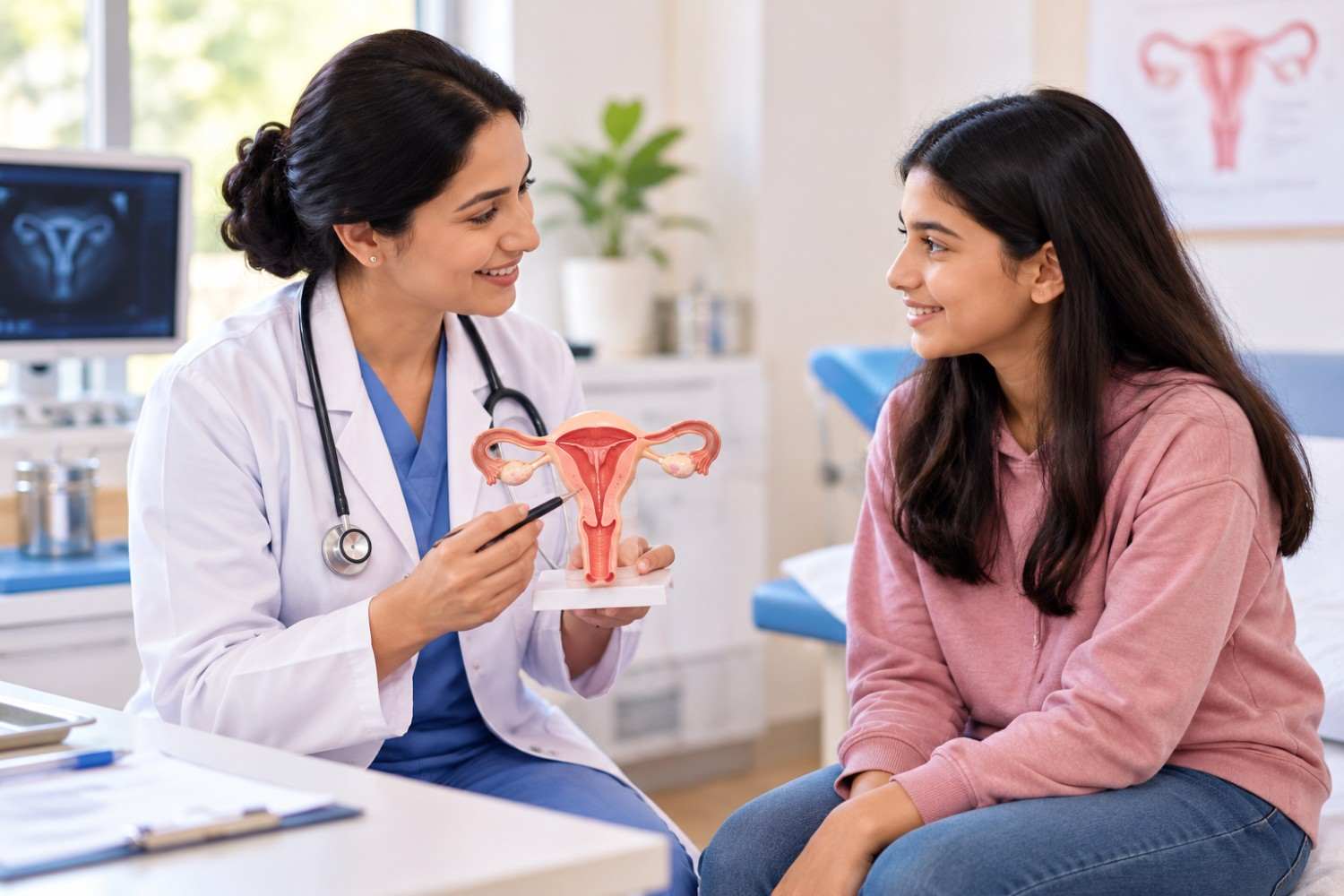
The teenage years bring many changes, and with them come questions that girls and parents often find hard to ask: Are my periods normal? Why is the pain so bad? Why are my periods irregular? Is this discharge normal? Many of these concerns are common and treatable, but they are often ignored out of embarrassment or the belief that nothing can be done. Adolescent gynaecology offers a safe, respectful place to ask these questions and get honest, age-appropriate answers.
This page explains the common gynaecological concerns of adolescent girls, when to seek advice, what to expect at a first visit, and how problems are evaluated and treated. It is general educational information for young women and their parents. Your own plan can only be made after a personal consultation.

Adolescent gynaecology is the care of the reproductive and menstrual health of girls and young women, generally during the teenage years, from the start of puberty to early adulthood. It covers normal development, menstrual problems, pelvic pain, infections, hormonal and growth concerns, vaccination and preventive advice, and, when appropriate, contraception and sexual health education. The approach is gentle, explanatory and tailored to the age and comfort of the young woman.
Puberty usually begins between about 8 and 13 years of age, with breast development followed by the growth of body hair. The first period, called menarche, typically occurs about two to three years after breast development begins, commonly around 12 to 13 years, though it can be normal anywhere from about 9 to 15 years.
In the first year or two after periods start, cycles are often irregular, because ovulation is still settling into a pattern. Cycles in adolescents commonly range from about 21 to 45 days, and bleeding generally lasts up to seven days. This irregularity is usually normal, but some patterns need checking, which are described below.
Proactive guidance and preventive care help young women build a strong foundation for lifelong reproductive and general health:
Many menstrual, hormonal, and developmental concerns during the teenage years are common and respond well to timely, reassuring care.
Mild to moderate cramps are common in teenagers and often improve with simple measures and pain relievers. Pain that is severe, keeps a girl from school or normal activities, or does not respond to usual treatment should be evaluated, as it may be related to conditions such as endometriosis, which can begin in adolescence.
Heavy or prolonged periods in teenagers are often related to immature ovulation, but they can also be a sign of a bleeding disorder or other medical problem. Heavy bleeding can cause anaemia, with tiredness, dizziness and poor concentration, so it should not be dismissed.
Irregular periods are common early on, but cycles that remain very irregular, very infrequent, or that stop after being regular, need evaluation. Causes include stress, weight changes, intense exercise, thyroid problems, PCOS and other hormonal conditions.
Doctors recommend an evaluation if periods have not begun by about 15 years of age, or within about three years after breast development began, or if there are no signs of puberty by about 13 years. Reasons include delayed puberty, hormonal conditions, low body weight and, less commonly, anatomical differences of the reproductive tract. Please see our page on irregular periods for related information.
PCOS can begin in adolescence, with irregular periods, acne, excess hair growth and weight gain. Because irregular cycles are normal in the early years, diagnosis is made carefully and often requires follow-up over time. Lifestyle measures are the foundation of care. Please see our page on PCOD / PCOS.
Clear or white discharge is normal in girls approaching and after puberty. Discharge that is itchy, foul-smelling, coloured or associated with pain needs evaluation. Please see our page on white discharge.
Most ovarian cysts in teenagers are functional and resolve on their own, but persistent or severe pain, especially if sudden, needs prompt assessment. Please see our page on ovarian cysts.
Breast development before about 8 years of age, or periods starting very early, as well as no signs of puberty by the early teens, should be evaluated, sometimes together with a paediatric endocrinologist.
These can be related to hormonal changes and PCOS, and they affect confidence and mood. A gynaecologist can assess whether a hormonal cause is present and coordinate care with a dermatologist or dietitian.
Breast lumps in teenagers are most often benign, but any lump, pain or change deserves a check. Other concerns, such as hygiene, sanitary products and menstrual cups or tampons, can also be discussed.
A first visit to a gynaecologist does not necessarily involve an internal examination. In most teenagers with period problems, the visit is mainly a conversation, with a general check-up and, if needed, an abdominal ultrasound and blood tests. A pelvic or internal examination is rarely needed in young women who have not been sexually active, and is done only when necessary, with explanation and consent.
You can bring your parent or guardian, or ask to speak to the doctor alone for part of the visit, depending on your comfort.
The doctor will ask about your periods, pain, growth, health, family history, diet, exercise and emotional wellbeing. It helps to note the dates of your last few periods before the visit.
The consultation is private, and questions of any kind are welcome. Concerns about safety or abuse are taken seriously and handled with care, in line with the law.
Many guidelines suggest that a first reproductive health visit can take place in the early teens, even if there are no problems, mainly for education and reassurance.
How adolescent gynaecological concerns are investigated and managed, and how parents can support their daughter's health.
Evaluation depends on the concern. It may include a history and examination, blood tests (such as haemoglobin, thyroid and hormone tests), an ultrasound, and, when needed, tests for bleeding disorders or infections. Treatment is individualised and may include reassurance and monitoring, pain relief, iron supplementation, hormonal treatment to regulate periods or reduce pain and bleeding, treatment of infections, lifestyle and nutritional guidance, or referral to a related specialist.
Thoughtful Management: Hormonal medicines are used thoughtfully in adolescents, with attention to the benefits, side effects and long-term plans. Surgery is rarely needed and is reserved for specific problems.
Dr. Sunita Arora is an obstetrician, gynaecologist and laparoscopic surgeon with more than 23 years of experience. She holds an MBBS from Lady Hardinge Medical College, New Delhi, and an MD in Obstetrics and Gynaecology from UCMS and GTB Hospital, and she is a Fellow of the Indian College of Obstetricians and Gynaecologists (FICOG) and a Fellow of the International College of Surgeons (FICS). She completed a fellowship in Reproductive Medicine at D.Y. Patil University, Mumbai.
Her practice covers general gynaecology, pregnancy care and infertility, and young women and their families are seen in a private, comfortable and respectful setting.
If you or your daughter have questions about periods, pain, discharge or development, a gentle, private consultation can provide reassurance and, if needed, treatment.
She consults at Safdarjung Enclave and is also associated with Fortis La Femme, Greater Kailash II, serving families across South Delhi, including Greater Kailash, Green Park, Hauz Khas and nearby areas.
Dr Sunita Arora Fertility and Gynae Clinic
Fortis La Femme, South Delhi
Book an appointment with Dr. Sunita Arora, and bring any previous reports.
Find answers to common questions about adolescent gynaecology, puberty, irregular or painful periods, and what to expect at a first visit.
Medical disclaimer: This page is for general educational purposes and does not replace personalised medical advice, diagnosis or treatment. Please consult a qualified doctor about your own health. If you have severe abdominal pain, heavy bleeding, fainting or fever, seek urgent medical care.