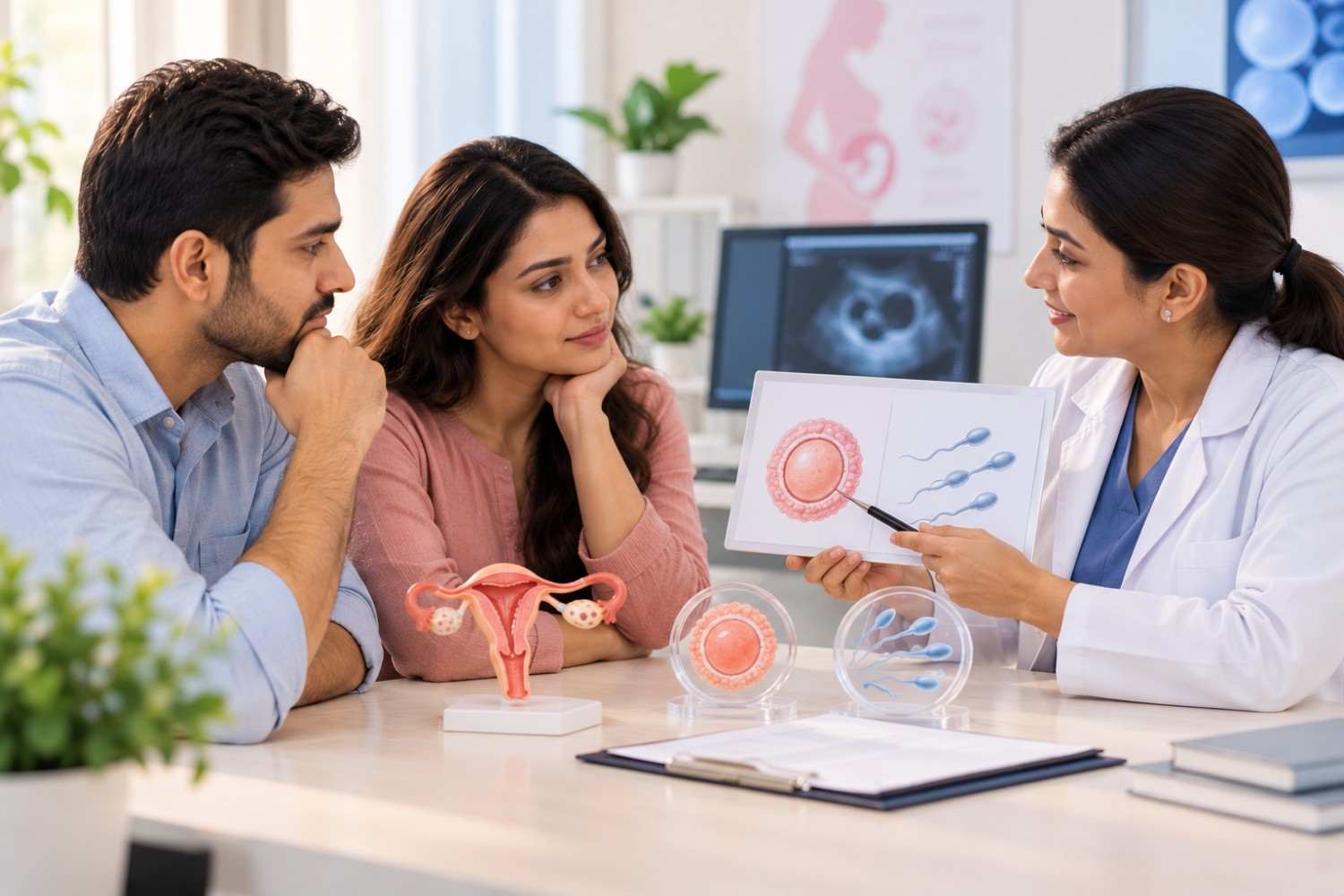
For some people, the path to parenthood includes donor eggs or donor sperm. Reaching this decision is rarely easy. It may follow years of treatment, a difficult diagnosis or a medical reason that makes using your own gametes unlikely to succeed. A consultation about donor gamete treatment is a place to ask questions, understand the medical, emotional and legal aspects, and decide at your own pace whether this option is right for you.
This page explains when donor eggs or donor sperm may be considered, how the evaluation and counselling are carried out, how donors are sourced and screened, and what the treatment involves. It is general educational information. Your own plan can only be made after a personal consultation.
Donor gamete treatment means using eggs (oocytes) or sperm from a screened donor, rather than from one or both partners, to achieve a pregnancy through fertility treatment. Donor eggs are used with IVF, in which the eggs are fertilised in the laboratory and the resulting embryo is transferred to the recipient's uterus. Donor sperm may be used with IUI or with IVF or ICSI, depending on the situation.
In India, assisted reproductive technology is regulated under the Assisted Reproductive Technology (Regulation) Act, 2021 and its rules. Under this framework, donor gametes are sourced through ART banks registered with the National Registry, not arranged privately. Legal provisions are updated from time to time, so your doctor will confirm the current requirements with you.
Donor eggs may be discussed in situations such as:
Donor sperm may be considered when:
There are no sperm in the semen (azoospermia) and sperm cannot be retrieved, or retrieval has been unsuccessful.
There is severe male factor infertility that has not responded to other treatment.
There is a significant risk of transmitting a serious genetic or inherited condition.
Previous treatment with the partner's sperm has failed repeatedly, and the cause is attributed to sperm.
Where the law permits, other individuals or couples may also be eligible. Your doctor will explain who can access treatment under the current rules.
A donor gamete cycle is planned carefully, and the recipient is evaluated just like any patient undergoing IVF.
A detailed history and examination, an ultrasound of the uterus and ovaries, and blood tests, including infection screening, are standard. Hysteroscopy may be advised to ensure that the uterine cavity is healthy. A review of general medical health, including blood pressure, blood sugar, thyroid function and fitness for pregnancy, is important, particularly for older recipients, as pregnancies using donor eggs may carry a higher risk of certain complications, such as high blood pressure in pregnancy.
A semen analysis and, when relevant, further tests are advised so that the whole couple is considered. If donor eggs are planned, the partner's sperm quality will influence whether IVF or ICSI is needed.
Counselling is as important as the medical evaluation. A good consultation allows time to talk through:
Understanding how donor egg and donor sperm treatments are carried out, along with sourcing, screening, and realistic expectations.
The recipient's uterine lining is prepared with hormone medicines, and ultrasound monitoring checks the lining. Donor eggs are fertilised with the partner's sperm in the laboratory, and one or two embryos are transferred to the recipient's uterus, depending on the situation and the guidance followed. Embryos not transferred may be frozen if suitable, subject to the applicable rules.
Donor sperm may be used for IUI, in which prepared sperm is placed in the uterus around ovulation, or for IVF or ICSI when the woman has other fertility problems. The choice depends on age, ovarian reserve, tubal status and previous treatment.
After a transfer or insemination, you will be advised on medicines, activity and when to take a pregnancy test. Support is continued through early pregnancy.
In keeping with the regulations, donor eggs and sperm are provided by ART banks that are registered with the National Registry of Banks and Clinics. Donors are screened according to the legal and medical requirements, including age limits and testing for infections. As a general principle under the law, a donor's gametes cannot be supplied to more than one commissioning party, and the donor does not acquire parental rights over the child.
Matching is based on practical and medical considerations such as general physical characteristics and blood group, and it is not possible to guarantee any specific trait. The identity of the donor is kept confidential.
The outcome of a donor egg cycle is influenced mainly by the age and quality of the donor eggs, the health of the recipient's uterus, embryo quality and the recipient's overall health. Donor sperm cycles are influenced by the woman's age and fertility status. No treatment can guarantee a pregnancy or a live birth, and your doctor will discuss realistic expectations for your situation without making promises.
The risks of fertility treatment include the side effects of hormone medicines, the risks of procedures, the possibility of a multiple pregnancy if more than one embryo is transferred, and the risks associated with pregnancy itself. Your doctor will explain these in detail and obtain your informed consent.
Dr. Sunita Arora is an obstetrician, gynaecologist and fertility specialist with more than 23 years of experience. She holds an MBBS from Lady Hardinge Medical College, New Delhi, and an MD in Obstetrics and Gynaecology from UCMS and GTB Hospital, and she is a Fellow of the Indian College of Obstetricians and Gynaecologists (FICOG) and a Fellow of the International College of Surgeons (FICS). She completed a fellowship in Reproductive Medicine at D.Y. Patil University, Mumbai, and received IVF training at RMA, Mount Sinai, New York.
Her special interests include infertility, IUI and IVF, and patients are guided through each step in clear, plain language, with attention to their emotional wellbeing.
If you are considering donor eggs or donor sperm, an unhurried, confidential consultation can help you understand your options and decide what feels right.
She consults at Safdarjung Enclave and is also associated with Fortis La Femme, Greater Kailash II, serving couples across South Delhi, including Greater Kailash, Green Park, Hauz Khas and nearby areas.
Dr Sunita Arora Fertility and Gynae Clinic
Fortis La Femme, South Delhi
Book an appointment with Dr. Sunita Arora, and bring your previous reports and treatment records.
Find answers to common questions about donor egg and donor sperm regulations, matching, parental rights, timelines, and expectations.
Medical disclaimer: This page is for general educational purposes and does not replace personalised medical or legal advice, diagnosis or treatment. Laws and regulations on assisted reproduction change from time to time. Please consult a qualified doctor about your own health. If you have severe abdominal pain, heavy bleeding, fainting or fever, seek urgent medical care.