Book Appointment

Ovarian Cysts: Management and Treatment in South Delhi

Ovarian Cysts: Management and Treatment in South Delhi - Dr Sunita Arora
Gynaecology & Laparoscopic Care

Ovarian Cysts

Hearing that an ultrasound has found a cyst on your ovary can be worrying, especially when the word is not explained. The reassuring fact is that most ovarian cysts are benign, many cause no symptoms and a large number disappear on their own. Some, however, need monitoring or treatment, and a few need prompt attention. Knowing which is which is the purpose of a proper evaluation.

This page explains what ovarian cysts are, the different types, their symptoms, how they are diagnosed, and how they are managed, from watchful waiting to laparoscopic surgery. It is general educational information. Your own plan can only be made after a personal consultation.
What Is an Ovarian Cyst?

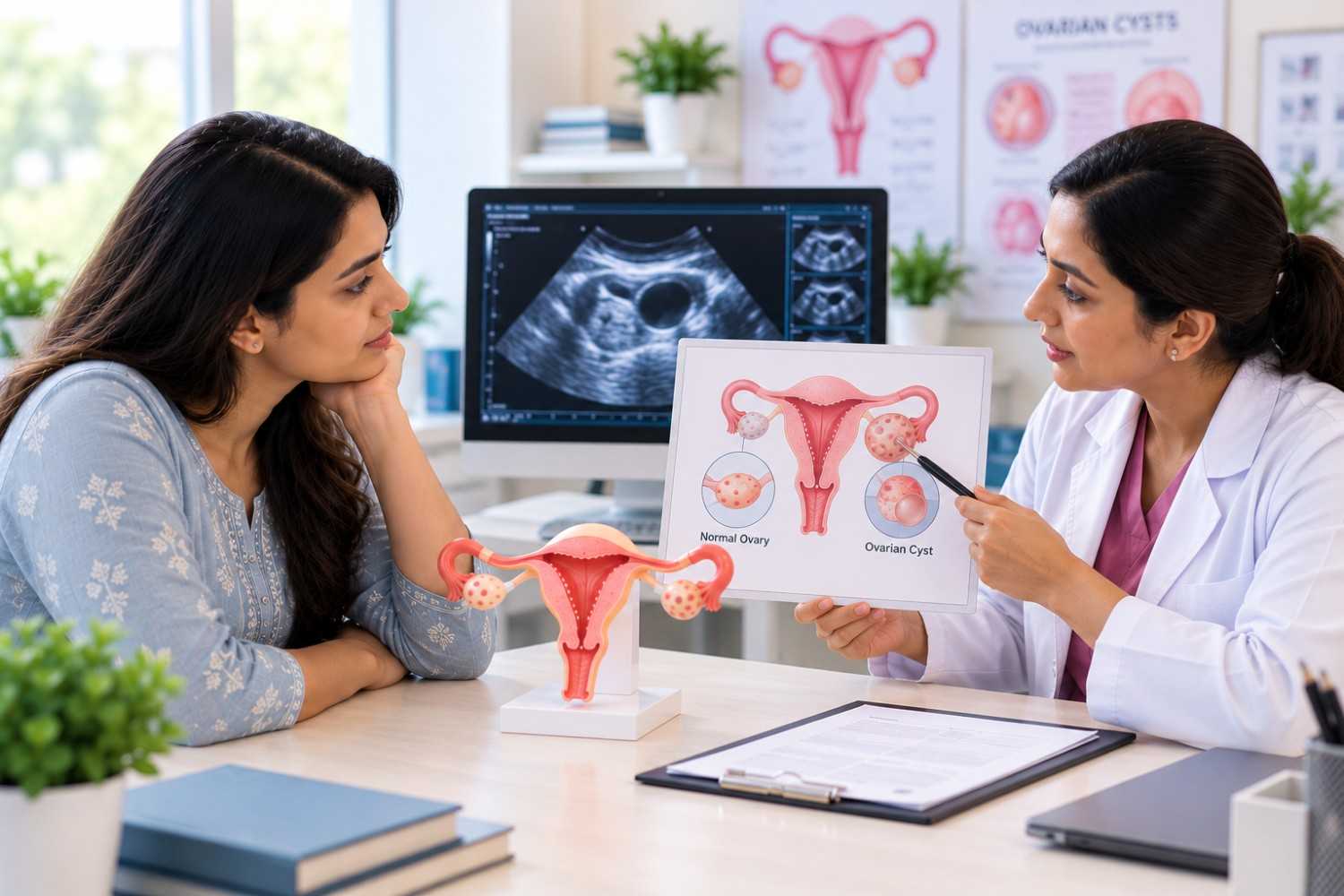
An ovarian cyst is a fluid-filled or semi-solid sac that develops on or within an ovary. Cysts are very common during the reproductive years and can occur at any age, including after menopause. They vary from a few millimetres to many centimetres, and a woman can have one or more, on one or both ovaries.

When Should You See a Doctor?

Please consult a gynaecologist if a scan has shown an ovarian cyst, if you have persistent pelvic pain or bloating, if your cysts keep coming back, if a cyst is growing, or if you have found a cyst after menopause. Early evaluation is also helpful if you are trying to conceive.

Urgent Care: Seek urgent medical care if you have sudden, severe abdominal or pelvic pain, particularly with vomiting, fever, dizziness or fainting. This may indicate a ruptured cyst or ovarian torsion (twisting of the ovary), which needs prompt treatment.

Symptoms of Ovarian Cysts

Most small cysts cause no symptoms and are found by chance during a scan. When symptoms occur, they may include:

Dull or sharp pain in the lower abdomen or pelvis, often on one side.
A feeling of fullness, pressure or bloating.
Pain during intercourse or bowel movements.
Changes in periods, such as irregular or heavy bleeding.
Frequent urination or difficulty emptying the bladder.

Types of Ovarian Cysts

Ovarian cysts are classified based on how they develop and what they contain, ranging from normal cycle-related sacs to other benign growths.

Functional Cysts

These are the most common and are related to the normal menstrual cycle. A follicular cyst forms when a follicle does not release its egg and keeps growing. A corpus luteum cyst forms after ovulation if the empty follicle fills with fluid or blood. Functional cysts are usually harmless and often disappear within a few cycles.

Endometriomas ('Chocolate Cysts')

These cysts are caused by endometriosis, in which tissue similar to the uterine lining grows in the ovary and fills the cyst with old blood. They may cause pain and can affect fertility. Please see our page on endometriosis for more detail.

Dermoid Cysts (Mature Cystic Teratomas)

Dermoid cysts are benign growths that may contain tissue such as fat, hair or skin. They tend to grow slowly and are usually removed when they are large, growing or causing symptoms.

Cystadenomas

These benign cysts develop from the surface cells of the ovary and are filled with watery or mucus-like fluid. They can grow quite large and are usually treated surgically.

Polycystic-Appearing Ovaries

In polycystic ovary syndrome (PCOS), the ovaries contain many small immature follicles. These are not true cysts that need to be removed, and the condition is managed as a hormonal problem. Please see our page on PCOD / PCOS.

How Ovarian Cysts Are Diagnosed

A structured evaluation clarifies the size, position, and nature of the cyst to guide whether monitoring or treatment is needed.

Step 01

History and Examination

Your doctor will ask about your symptoms, periods, pregnancy plans, family history of ovarian or breast cancer and any previous cysts. A pelvic examination may be performed.

Step 02

Pelvic Ultrasound

Ultrasound, usually transvaginal, is the main test. It shows the size and position of the cyst and whether it looks simple (smooth, thin-walled and fluid-filled) or complex (with solid parts, thick walls or internal divisions). This appearance guides what happens next.

Step 03

Blood Tests

A pregnancy test is done where relevant. A tumour marker called CA-125 may be advised in selected cases, particularly in women past menopause or when the cyst looks suspicious, but it can be raised by benign conditions such as endometriosis, so it must be interpreted with care. Other tests may be added depending on your age and the scan appearance.

Step 04

MRI or Other Imaging

MRI may be used when the ultrasound findings are unclear, to better characterise a cyst, or for surgical planning.

Treatment and Management of Ovarian Cysts

The right approach depends on the type, size and appearance of the cyst, your symptoms, your age and menopausal status, and whether you want to have children.

Watchful Waiting

Small, simple cysts, especially functional cysts in women who are still having periods, often resolve on their own over a few menstrual cycles. They are usually monitored with a repeat ultrasound after a suitable interval, and the follow-up plan is set by your doctor according to the cyst.

Medicines

Pain relievers can ease discomfort. Hormonal contraceptive pills are sometimes used to reduce the formation of new functional cysts in women who keep developing them, but they do not shrink a cyst that is already present. Cysts due to endometriosis or other causes need treatment of the underlying condition.

Laparoscopic Surgery

Surgery is considered for cysts that are large, persistent, growing, painful or complex in appearance, and for dermoid cysts, endometriomas and other cysts that are unlikely to resolve. Laparoscopic cystectomy removes the cyst through small keyhole incisions while preserving as much healthy ovarian tissue as possible, which is especially important for women who want to conceive. Recovery is usually faster than after open surgery. Please see our page on laparoscopy for more detail.

Open Surgery

A larger incision may be needed for very large cysts or when there is a concern that a cyst could be cancerous, to allow complete and careful removal without spilling the contents.

Removal of the Ovary

In some situations, such as a severely damaged ovary, a twisted ovary that cannot be saved or, after menopause, when a cyst looks suspicious, removal of the ovary (oophorectomy) may be advised. Your doctor will discuss this with you in advance wherever possible.

Emergency Treatment

Ovarian torsion or a ruptured cyst with significant bleeding is a surgical emergency. Prompt surgery can often save the ovary in torsion, so early presentation matters.

As with any surgery, the risks include bleeding, infection, injury to nearby organs, anaesthesia-related risks and, for some cysts, a small effect on ovarian reserve. Your doctor will explain the specific risks of the procedure proposed for you.

Fertility, Pregnancy & Post-Menopause Care

How ovarian cysts are evaluated when planning a pregnancy, during gestation, or after menopause.

Conception & Pregnancy

Ovarian Cysts and Fertility

Most ovarian cysts, particularly functional cysts, do not affect fertility. Endometriomas, and surgery for larger cysts, can reduce ovarian reserve to some degree, so decisions about surgery are made carefully in women who wish to conceive. Your doctor may check AMH and perform an antral follicle count to plan treatment. Please see our pages on female infertility and hormonal assessment for the broader evaluation.

Cysts During Pregnancy: Cysts found during pregnancy are mostly benign and are often monitored, with treatment reserved for those causing complications. Surgery, when needed, is usually timed carefully and performed with safety for both mother and baby in mind.

Post-Menopause Guidance

Ovarian Cysts After Menopause

A new ovarian cyst after menopause needs careful evaluation, because the likelihood of a serious cause is higher than in younger women.
Simple small cysts are often benign and can be monitored, whereas complex cysts or rising tumour markers prompt further investigation and, often, surgery.
Specialist Expertise

Consult Dr. Sunita Arora for Ovarian Cysts in South Delhi

Dr. Sunita Arora is an obstetrician, gynaecologist and laparoscopic surgeon with more than 23 years of experience. She holds an MBBS from Lady Hardinge Medical College, New Delhi, and an MD in Obstetrics and Gynaecology from UCMS and GTB Hospital, and she is a Fellow of the Indian College of Obstetricians and Gynaecologists (FICOG) and a Fellow of the International College of Surgeons (FICS). She completed a fellowship in Reproductive Medicine at D.Y. Patil University, Mumbai.

Her special interests include endoscopic surgery and infertility, so that decisions about monitoring or surgery take your fertility plans into account.

If an ultrasound has shown an ovarian cyst, or you have pelvic pain or bloating, a careful evaluation can tell you whether it needs monitoring or treatment.

Clinic Locations

Book a Consultation

She consults at Safdarjung Enclave and is also associated with Fortis La Femme, Greater Kailash II, serving women across South Delhi, including Greater Kailash, Green Park, Hauz Khas and nearby areas.

01
Safdarjung Enclave

Dr Sunita Arora Fertility and Gynae Clinic

02
Greater Kailash II

Fortis La Femme, South Delhi

Book an appointment with Dr. Sunita Arora, and bring your previous scans and reports.

Frequently Asked Questions

Find answers to common questions about ovarian cysts, symptoms, diagnosis, fertility, and treatment options.

No. Many cysts, especially small functional cysts, resolve on their own and only need monitoring. Treatment is advised for cysts that are large, persistent, growing, painful or suspicious.

Most ovarian cysts are benign, and functional cysts do not become cancer. Cancer in a cyst is uncommon, and the risk is higher after menopause or when a cyst has suspicious features on scan, which is why ultrasound features and follow-up matter.

Most do not. Some types, such as endometriomas, and surgery on the ovary can affect ovarian reserve, so a fertility-sparing approach is chosen when you want to conceive.

There is no single cut-off. The decision depends on the appearance of the cyst, its growth, symptoms, your age and your plans, and not just its size. Your doctor will explain the reasoning in your case.

A removed cyst does not usually return, but new cysts can form, and some types, such as endometriomas, have a tendency to recur. Follow-up is advised.

Sudden, severe abdominal or pelvic pain, often with nausea, vomiting, fever, dizziness or fainting, requires urgent medical attention.

Medical disclaimer: This page is for general educational purposes and does not replace personalised medical advice, diagnosis or treatment. Please consult a qualified doctor about your own health. If you have severe abdominal pain, heavy bleeding, fainting or fever, seek urgent medical care.